Factory · mark harness
Factory brand lab
Two coordinated icon systems for the four core tenets come first. The final mark synthesis and complete iteration trail follow below. Every idea is tested at both presentation and small-icon scale.
Documentation · diagram atlas
Concept visuals in context
The complete relationship-heavy documentation set. Each preview links to the page where the diagram carries the explanation.
Owned Paths
Open documentation page →Verification gate
Open documentation page →Agent-ready ticket
Open documentation page →Offline demo
Open documentation page →First real PR
Open documentation page →Harness routing
Open documentation page →Gondolin boundary
Open documentation page →Kernel and packs
Open documentation page →Multi-repo fleet
Open documentation page →Infrastructure ops loop
Open documentation page →Core tenets · two directions
One family, four principles
System A inherits the chamfered aperture mark. System B translates the same semantics into a more operational rail language.
System A
Aperture family
Directly extends the finalist mark through chamfered boundaries and load-bearing gates.

One ticket, one worktree
Two complete regions exist because one shared teal wall keeps them disjoint.

Verification as a gate
A bounded run can continue only through the short verification gate.

Pluggable control plane
One stable spine docks into interchangeable tracker apertures.

Multi-harness architecture
One control input drives three independent chamfered lanes.
System B
Rail family
A more operational language built from tracks, switch points, docking ports, and gates.

One ticket, one worktree
A worktree leaves the main rail for its own isolated siding.

Verification as a gate
Only the evidence rail crosses the gate; commentary stops short.

Pluggable control plane
Two tracker ports meet the same stable control span.

Multi-harness architecture
A single switch fans control into three parallel harness rails.
Factory mark · full trail
Final synthesis and iterations
Round four remains the leading mark comparison; earlier rounds document how the recursive aperture was reduced.

Chamfered Recursion
Nested self-similar apertures converge on one load-bearing verification gate before the accepted exit.

Continuous Recursion
One path unfolds from a small bounded envelope into a larger copy and crosses a short verification gate.
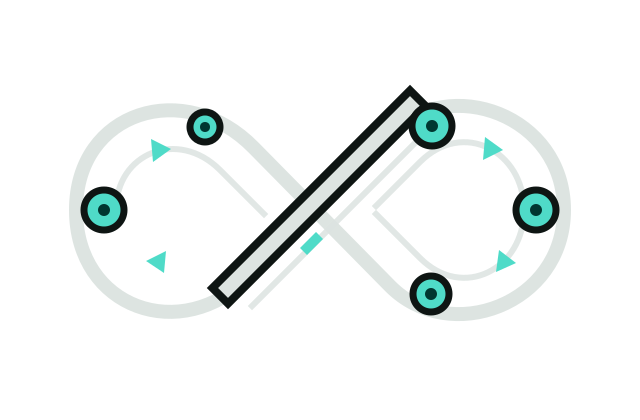
Engineering loop
The current homepage experiment: expressive, but busy at small sizes.
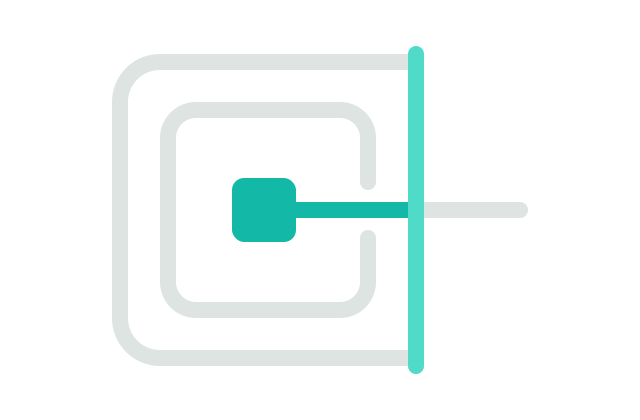
Recursive Gate — refined
Nested bounded execution meets one load-bearing verification gate and exits as accepted evidence.
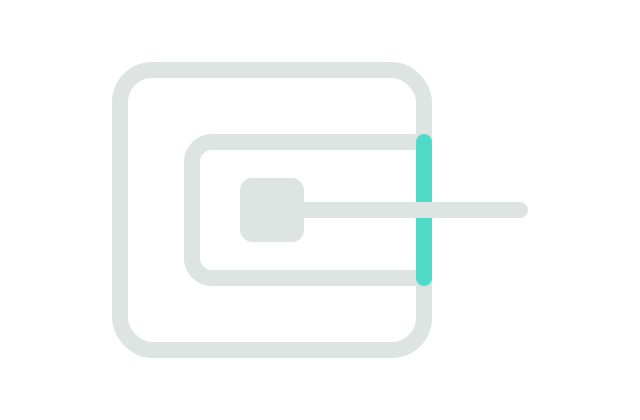
Integrated Gate
A closed envelope and docked inner boundary share one teal gate, with accepted work continuing through it.
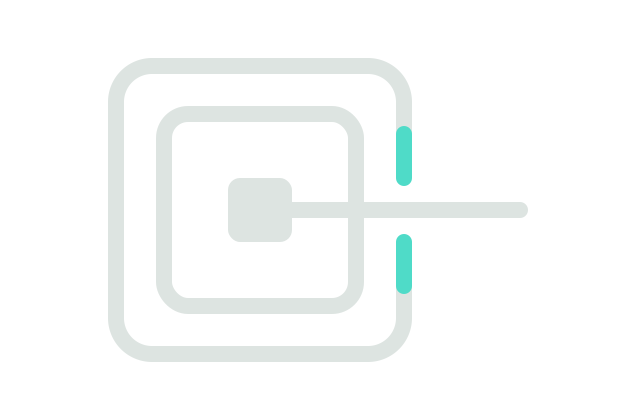
Verification Seam
Two bounded execution envelopes open only at a marked verification seam.

Recursive Aperture
One continuous recursive path grows from a core, crosses its outer boundary, and leaves a verified result.

Dynamic Aperture
Parallel chamfers add forward motion while the verified gate sits directly in the exit run.

Continuous Gate
The path itself changes from warm white to teal as accepted work crosses the outer boundary.

Reduced Aperture
A smaller open aperture repeats inside the outer one, replacing maze-like turns with true self-similarity.

Precision Loop
A continuous loop reduced to two circles, two tangents, and one clear weave.
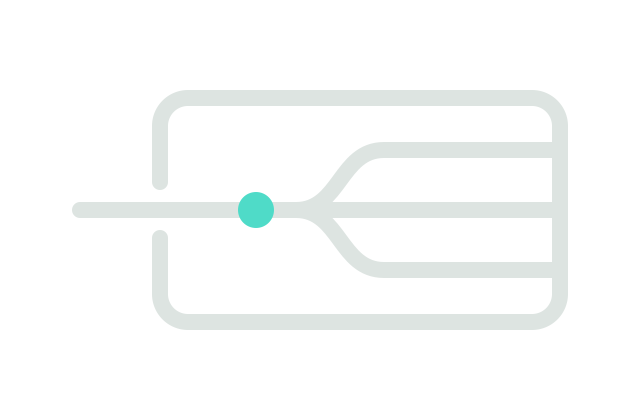
Control Plane
One admitted input reaches a deterministic router and three bounded lanes.
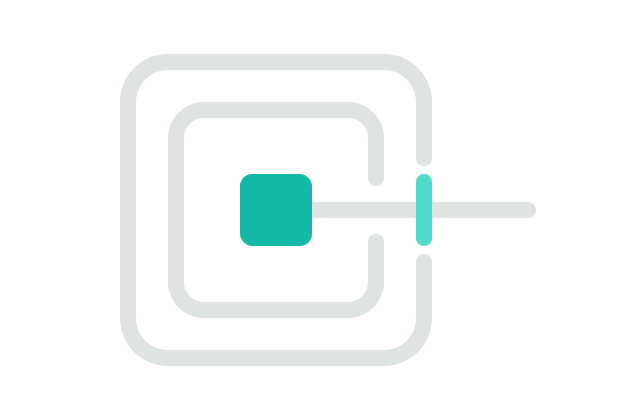
Recursive Gate
Nested execution boundaries, a bounded core, and one visible acceptance gate.
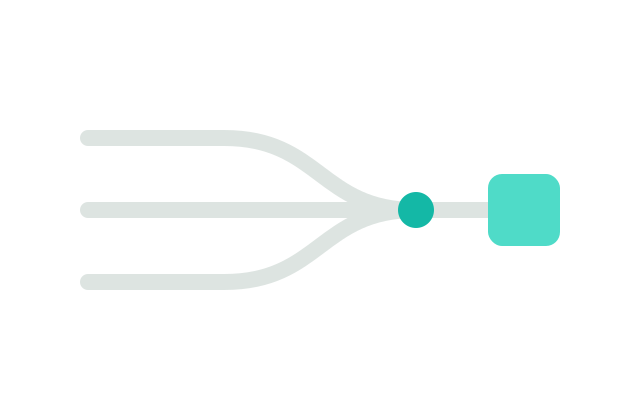
Bounded Flow
Parallel paths converge through verification into one durable result.